As an Amazon Associate, we earn from qualifying purchases. Some links on this site are affiliate links at no extra cost to you. Our recommendations are based on thorough research and editorial judgment.


What Advanced RC Truck Racing Techniques Work?

In advanced RC truck racing, Smooth Throttle Control helps us maximize grip by modulating acceleration, while Braking Precision enhances stability during turns. We optimize our racing line by identifying key turn-in points for speed maintenance. Weight Transfer and Suspension Tuning improve grip by lowering the center of gravity and adjusting dampers. Using Drifting Techniques allows us to navigate corners effectively. By implementing these strategies, we enhance performance and consistency, revealing further insights into competitive racing techniques.
Key Takeaways
- Utilize smooth throttle modulation and the “nitro finger” technique to enhance acceleration without wheel spin.
- Focus on racing line optimization by segmenting the track for improved exit speeds.
- Adjust suspension settings and weight distribution for better grip and stability during cornering.
- Employ drifting techniques like feint drifts and controlled handbrake turns for sharper cornering.
- Maintain a consistent pace and mental focus to minimize errors and capitalize on overtaking opportunities.
Smooth Throttle and Braking Control
Smooth Throttle Application Techniques
In our RC truck racing journey, smooth throttle modulation is vital for maximizing performance. Gradually applying throttle gives our tires enough time to find grip, reducing wheel spin during acceleration. We should practice the “nitro finger” technique, tapping the throttle rhythmically from full to neutral, keeping RPMs ideal for traction. This helps us maintain control on tricky surfaces. Additionally, we need to smoothly release the brake before entering turns, allowing for better stability through the apex. Balancing throttle release with brake application aids in weight distribution, improving our grip. Remember, adjusting throttle endpoints prevents overextension, promoting efficiency in fuel use while enhancing our acceleration’s smoothness. These techniques strengthen our overall racing control, making our vehicles more predictable and effective. Furthermore, understanding high-speed RC truck specifications like motor types and battery life assists in optimizing our racing strategy.
Racing Line Optimization
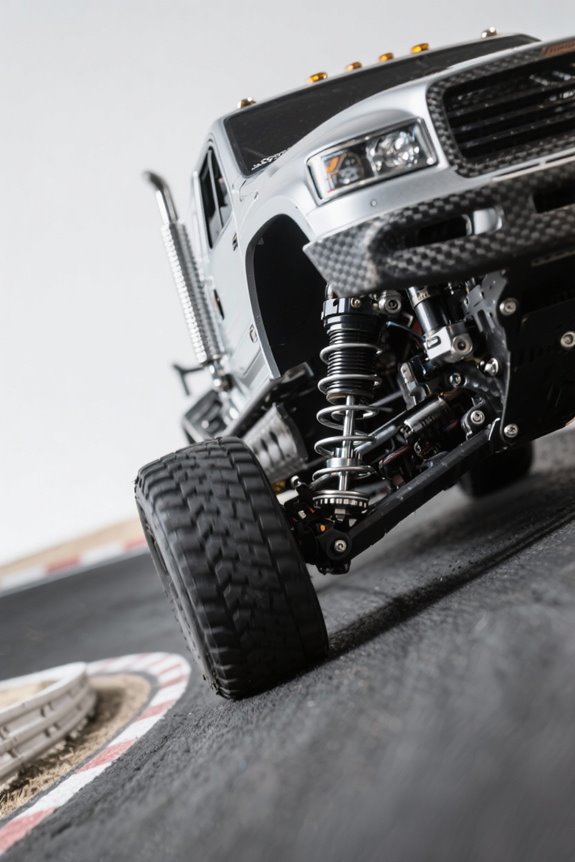
Understanding the Racing Line****
To optimize our racing line, we need to focus on track segmentation and how it affects velocity planning. Instead of merely seeking the shortest path, let’s aim for the path that allows for higher exit speeds, even if it is longer. By identifying the right turn-in points, we can brake later and maintain speed through the apex, enhancing our corner exits. Sharp turns should be approached with an understanding that sacrificing some cornering speed will lead to greater acceleration on straightaways. By employing advanced computational strategies, like trajectory planning and genetic algorithms, we can model our vehicle dynamics effectively. This optimization not only reduces lap times but also maximizes efficiency around technical corners, ultimately enhancing our overall performance. Additionally, considering performance features such as lockable differentials and high-speed capabilities in your RC truck can significantly influence your racing strategy.
Weight Transfer and Suspension Tuning

Weight transfer plays an essential role in how our RC trucks handle during cornering, affecting both grip and stability. Lateral Weight Transfer** occurs primarily when we navigate turns, and it’s influenced by the height of our center of gravity, track width, and lateral acceleration. For effective weight transfer dynamics, we should focus on lowering the center of gravity by positioning the battery as low and as far forward as possible. Suspension Calibration is key; tuning springs, dampers, and anti-roll bars helps control weight transfer timing, affecting traction. By strategically placing weights inside wheel rims, we enhance grip in rough terrain while balancing nimbleness. Together, these adjustments maximize stability, ensuring our RC trucks handle efficiently and confidently through every corner. Additionally, the use of high-performance motors** can significantly improve overall speed and responsiveness during racing events.
Drifting and Cornering Techniques
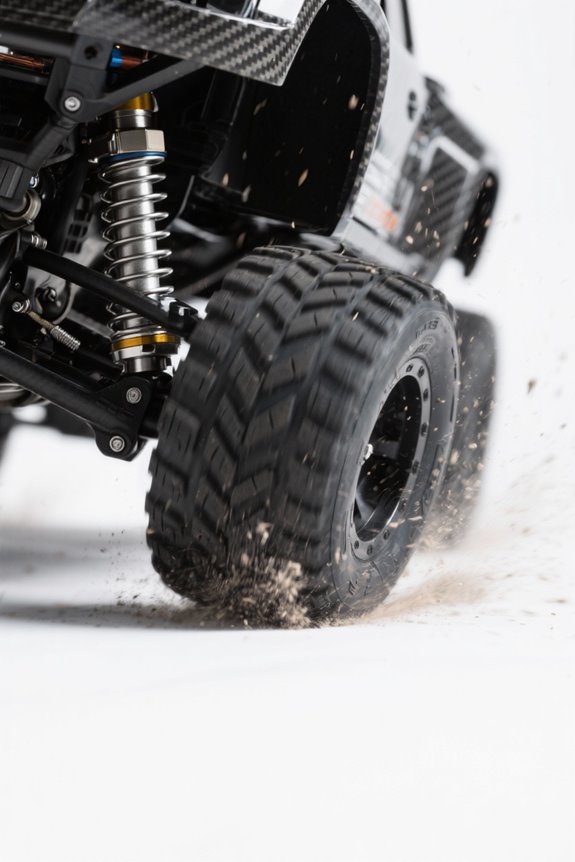
Drifting and cornering techniques are crucial for achieving speed and control in RC truck racing, particularly on varied surfaces. Drift Initiation Techniques involve multiple methods: using a Feint Drift allows us to momentarily steer away before entering the turn, which leverages momentum for a smooth rear-end slide. Handbrake Turns can mimic braking, inducing rear wheel slip necessary for maintaining our drift. As we approach the corner exit, applying throttle steadily guarantees a seamless shift back to grip. Throttle Management is essential—too much power spins us out, while too little shortens drifts. Countersteer Precision, using gentle inputs, helps maintain the desired drift angle, making our cornering sharper and faster, ultimately improving our overall lap time and racing performance. Additionally, understanding terrain handling is vital as it helps adapt to different surfaces, enhancing overall control during competitive racing scenarios.
Jumping and Aerial Control
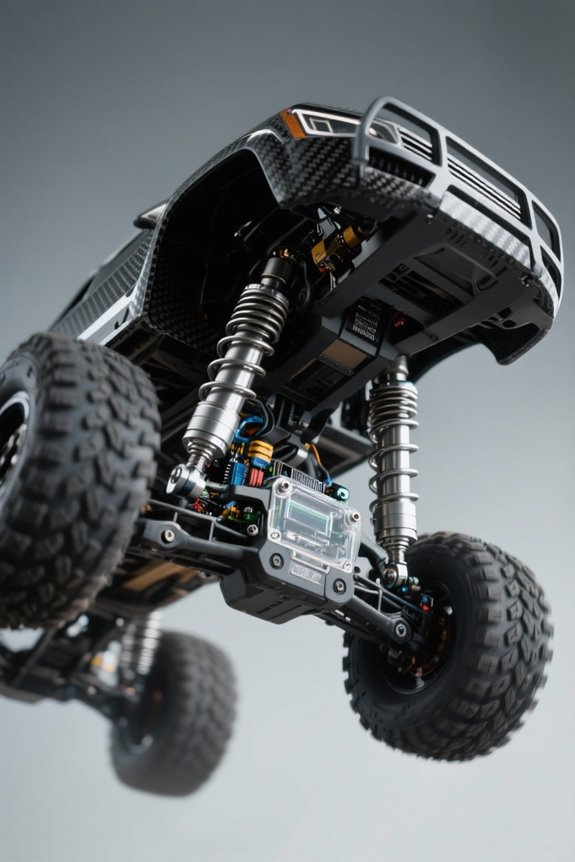
Jumping effectively requires mastering several key mechanics that guarantee a successful launch and controlled landing. Approach and Takeoff Mechanics emphasize building momentum before reaching the ramp, aiming for a consistent speed rather than a last-minute surge, which helps prevent the truck from nosing up mid-air. Approaching squarely enhances aerial stability and optimizes jump trajectory. Before takeoff, shifting weight forward increases rear tire traction for better power control. Lifting the throttle at the ramp lip maintains vehicle angle, preventing excessive nose-up takeoff. While airborne, neutral throttle balances the vehicle, and brief throttle or brake inputs can adjust pitch for smoother landings. Practicing these techniques leads to improved control and increased confidence on the track. Moreover, advanced suspension systems in some high-performance models help stabilize jumps and absorb impact during landings.
Race Strategy and Consistency
Mastering race strategy is just as important as perfecting jumping techniques. Maintaining a Steady Pace means we should focus on consistent speeds throughout the race—staying clear of risky maneuvers that could lead to crashes or costly errors. Proper race planning is essential; we aim for around 95% throttle control to manage speed effectively over long durations. By leveraging mental focus, we can stick to our strategy even when faced with setbacks. Additionally, patience is key; finding overtaking opportunities naturally keeps us in control. Finally, understanding track conditions enables us to adapt our racing lines without compromising our smooth throttle application, allowing for consistent lap times and vehicle reliability throughout the race. Choosing vehicles that excel on rough terrains enhances performance and increases reliability during challenging races.
Practice and Skill Development
Practicing effectively is essential for enhancing our skills in RC truck racing. Isolated Skill Practice targets individual elements of the track, like jumps, corners, and specific techniques, allowing us to build muscle memory and confidence. We can enhance our throttle control by starting with limited transmitter travel to 50%, smoothening our acceleration. Video Feedback is another useful tool; reviewing our laps lets us analyze performance and refine our driving lines. By observing difficult sections from track level, we better understand handling dynamics. Combining mastered skills into fluid laps helps optimize racing lines and speed. A focused practice environment enhances performance, ensuring safety and minimizing distractions while we endeavor for improvement, creating a more cohesive and skilled racing community. Additionally, understanding and applying advanced control systems can significantly improve maneuverability and responsiveness during races.
Frequently Asked Questions
What Tools Are Essential for Tuning an RC Truck?
For tuning our RC trucks, we need essential tools like hex drivers, camber gauges, and turnbuckle wrenches. These help us perfect our tuning techniques and performance upgrades, ensuring our trucks are race-ready and competitive!
How Can I Know My Ideal Throttle Percentage?
To find our ideal throttle percentage, we’ll calibrate our throttle settings and conduct track testing. By adjusting and observing our vehicle’s response, we’ll discover that sweet spot where power and traction align perfectly for success.
What’s the Best Surface for Practicing RC Truck Racing?
We believe the best practice surfaces for RC truck racing are smooth concrete or commercial-grade surfaces, as they offer excellent traction with minimized wear. Choosing the right surface materials helps us improve our driving skills considerably.
How Do Weather Conditions Affect RC Truck Performance?
Weather conditions greatly affect our RC truck performance. Rain reduces grip and makes us cautious, while temperature impacts tire and shock performance. Staying prepared helps us navigate these challenges together, ensuring we share the thrill of racing.
What Should I Consider When Choosing Tires for My RC Truck?
When choosing tires for our RC trucks, we should consider tire compounds and how they match our track conditions. Selecting the right combination enhances grip and performance, making our race experience more enjoyable together.


