As an Amazon Associate, we earn from qualifying purchases. Some links on this site are affiliate links at no extra cost to you. Our recommendations are based on thorough research and editorial judgment.


How To Fine-Tune RC Vehicle Differential Settings?

To fine-tune our RC vehicle differential settings, we should focus on differential tightness, adjusting it for traction—tight for high-traction surfaces, looser for low-traction areas. Next, we select the right fluid weight; heavier oils enhance grip during hard cornering, while lighter oils permit wheel speed variation. Regular maintenance is essential; inspect gears and seals to avoid oil loss. Finally, precise tuning can markedly enhance handling—modifications can dramatically alter our overall driveability, leading to improved performance. Exploring tweaks will reveal even more insights.
Key Takeaways
- Start with identifying track conditions to determine if tight or loose differentials are needed for optimal performance.
- Use a tuning screwdriver to make incremental adjustments to the differential tightness for better handling characteristics.
- Experiment with different fluid weights, ranging from 3000 to 10,000 viscosity, to refine traction and response during runs.
- Regularly inspect gears, lubricants, and seals to ensure smooth operation and prevent performance issues in your differential.
- Conduct test runs after each adjustment to evaluate differences and fine-tune settings for maximum effectiveness and control.
Understanding Different Types of Differentials
Understanding different types of differentials is essential for optimizing the performance of RC vehicles. Open Differentials allow wheels to spin at different speeds, enhancing turning but risking traction loss during sharp cornering. Locked Differentials (Spools) mechanically bind both wheels to rotate at the same speed, ensuring maximum power delivery while risking maneuverability. Limited Slip Differentials (LSD) intelligently manage power distribution, boosting traction without complete locking, making them versatile for various conditions. Ball Differentials use ball bearings for smooth operation and are favored in drift setups due to their adjustability, catering to precise handling. Finally, Gear Differentials rely on robust gear arrangements, offering greater durability and are better suited for rough tracks, ensuring longevity in performance. Popular among both novices and enthusiasts, brushless motors significantly improve the overall responsiveness and agility of RC vehicles.
Adjusting Differential Tightness for Track Conditions
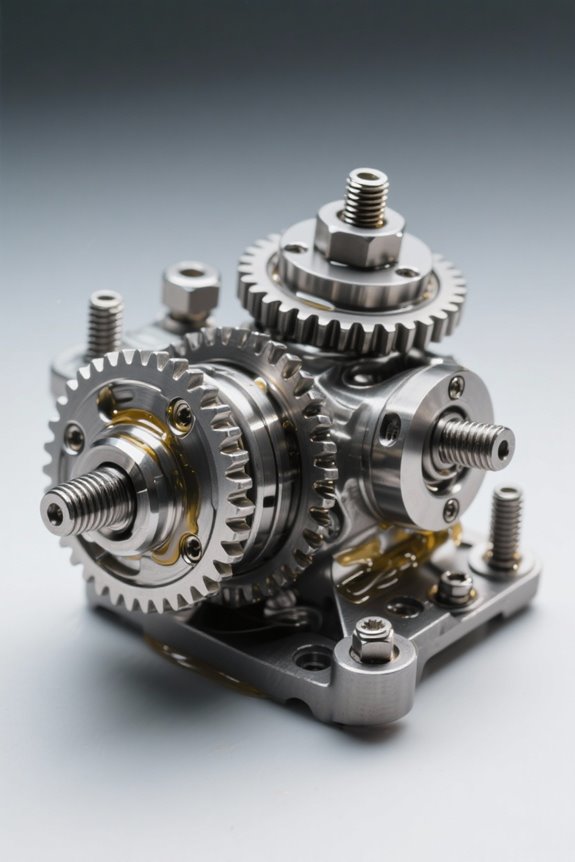
When we adjust differential tightness for varying track conditions, it’s crucial to balance traction and vehicle control. Tight Differentials provide enhanced forward drive and quicker acceleration, ideal for high-traction surfaces like asphalt or tightly packed dirt, as they minimize mid-corner rotation and maintain stability. For low-traction conditions, Looser Differentials allow for easier wheel slip, enhancing cornering smoothness and control. We should consider using a tuning screwdriver to make incremental changes, and grease can help fine-tune traction optimization without adding too much friction. After initial adjustments, performing test runs is important for refining settings. Overall, our differential adjustment can greatly impact our RC vehicle’s performance on various tracks. Notably, maintaining durability and construction materials in your RC vehicle can ensure effective handling during these adjustments. Let’s verify our settings match the conditions for maximum effectiveness.
Selecting the Right Differential Fluid Weight
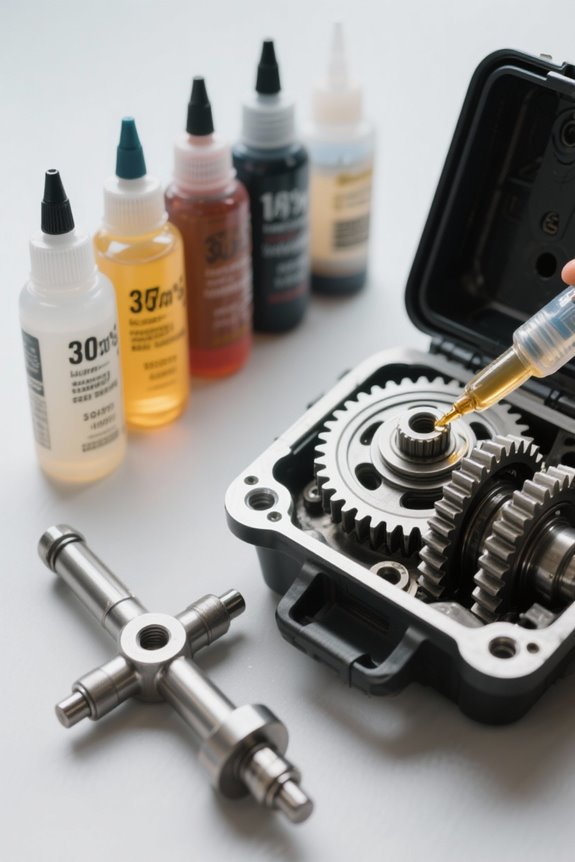
Selecting the right differential fluid weight is vital for enhancing vehicle performance under different driving conditions. Viscosity Influence: The oil’s weight directly affects how it resists flow within differential gears, impacting traction and power transfer. Heavier oils, like those rated at 30wt or higher, increase stiffness, offering better traction bias and on-power steering. Practical Application: This can help during hard corner exits. Conversely, lighter oils allow for more wheel speed variation but can lead to power loss at less traction. Manufacturer Standards: It’s important to adhere to manufacturer recommendations, as each brand uses different viscosity ratings, leading to varied oil performance. Experimenting with weights, such as 3000 to 10,000, enables us to refine our vehicle setup for ideal handling. Additionally, choosing the right upgrade parts can further enhance the overall performance of your RC vehicle.
Maintenance and Inspection for Optimal Performance
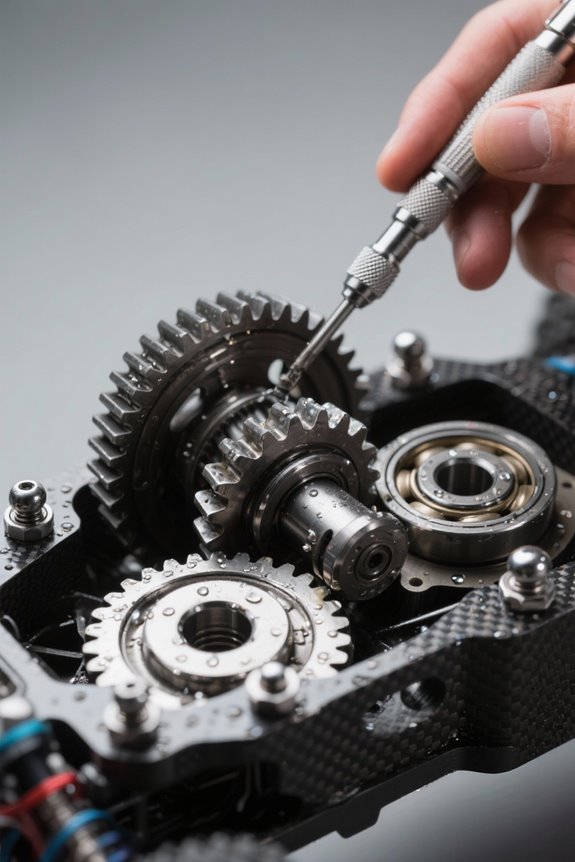
Regular maintenance and inspection of our RC vehicle’s differential is essential for achieving best performance and longevity. Differential Disassembly involves removing screws to prevent damage during cleaning. Before full disassembly, cleaning the differential aids in the removal of dirt and grease for thorough inspection. Gear Lubrication is critical; guarantee proper lubricants are applied to bearings and friction points to maintain smooth operation. We should inspect gears for cracks or uneven wear, and bearings must roll freely—clean or replace if gritty. Checking seals and O-rings for damage helps prevent oil loss, maintaining performance. Regularly replacing differential fluid every 40 to 50 runs based on driving conditions also guarantees consistent performance and prolongs component life. Additionally, using high-performing batteries such as Zeee 7.4V Lipo Battery can enhance overall vehicle capability during competitive racing. By following these practices, we can optimize our vehicle’s differential.
Installing One-Way Differentials

After ensuring our RC vehicle’s differential is properly maintained and functioning, we can explore the process of Installing One-Way Differentials.
Removal: First, we unscrew the retaining bolts to detach the existing front or center differential, then disassemble by sliding out shafts.
Preparation: Next, we remove old bearings and components to fit the one-way differential assembly, designed for peak one way performance.
Installation: We slide in the one-way diff, securing it with screws, ensuring free rotation in one direction.
Attachment: After that, we connect the one-way diff to the gear and outdrive cups, ensuring proper o-ring seals for stability.
Final Check: Finally, we spin the assembly to confirm alignment and smooth operation, following installation tips for a successful setup. An important step is to verify compatibility check to avoid any installation issues with specific RC models.
Impact of Differential Tuning on Handling and Driveability
When tuning the differentials in our RC vehicles, we must recognize how these adjustments greatly impact handling and driveability. Front Differential Fluid Viscosity affects differential responsiveness; lighter fluids increase off-power steering, enhancing corner entry but reducing stability on power, while heavier fluids improve on-power grip for smooth acceleration out of corners. Center Differential Tuning balances power distribution; thicker fluids increase responsiveness and driveability on smooth tracks, whereas lighter fluids enhance traction balance on rough surfaces. Rear Differential Settings influence corner exit; lighter fluids enhance traction for better acceleration, while heavier fluids boost cornering grip. By carefully adjusting these parameters, we can achieve an ideal balance between sharp steering and stability, ensuring our vehicles perform at their best across various track conditions. Proper tuning is essential for optimizing your vehicle’s performance, especially when considering battery options(2) to enhance runtime and overall reliability.
Frequently Asked Questions
How Do Differentials Affect Battery Life in RC Vehicles?
Differentials greatly influence battery efficiency in our RC vehicles. By optimizing settings and ensuring proper maintenance, we can minimize resistance and prolong battery life, keeping us racing longer and enjoying our time together on the track.
Can Differential Settings Improve Jump Performance in Off-Road Racing?
Absolutely, adjusting differential settings can drastically improve our jump technique in off-road racing. By complementing them with proper suspension tuning, we gain better control and stability, enhancing our performance and making every jump more predictable and exciting.
What Are Common Signs of Differential Failure?
We can spot common signs of differential failure by listening for unusual differential noises, monitoring tire wear, and noticing jerky movements. If our vehicle struggles, it’s time to investigate further together. Let’s keep our rides smooth!
How Often Should I Check My Differential Settings?
We should check our differential settings regularly, ideally every few runs or after significant track changes. This way, we guarantee peak performance, maintain consistency in differential maintenance, and keep our tuning frequency sharp for competitive edge.
Do Differentials Impact Tire Selection for Racing?
Yes, differentials do impact tire selection for racing. By adjusting differential settings, we can enhance traction control, ultimately minimizing tire wear. It’s essential to find that perfect balance for our racing success together.


