As an Amazon Associate, we earn from qualifying purchases. Some links on this site are affiliate links at no extra cost to you. Our recommendations are based on thorough research and editorial judgment.


How To Properly Calibrate RC Motorcycle ESC Settings?

To calibrate your RC motorcycle’s ESC settings, we must connect the ESC properly to the motor and receiver, guaranteeing secure wiring for signal integrity. Next, power on the transmitter with the throttle stick centered, then full throttle before connecting the battery for calibration. Listen for specific beeps indicating recognition of max throttle. We’ll also adjust throttle endpoints for accuracy, which enhances responsiveness. Following these steps effectively guarantees peak performance, and we can explore further optimizations.
Key Takeaways
- Ensure the ESC is securely connected to both the motor and receiver before starting the calibration process.
- Power on the transmitter with the throttle stick at neutral and centered throttle trim to initiate calibration.
- Set the throttle to maximum before connecting the battery, then quickly return it to neutral to recognize max throttle.
- Follow the specific calibration sequence outlined in the ESC manual to ensure proper settings are saved for performance.
- Conduct tests post-calibration to confirm accurate throttle response and perform visual checks for smooth motor operation.
Understanding ESC and Transmitter Setup
ESC Connection and Wiring to Transmitter and Receiver
To guarantee proper communication, we should connect the ESC signal wire to the throttle channel (usually CH2) of the receiver. Before powering on, let’s verify polarity and connector matching to avoid short circuits or ESC damage. It’s essential to use connectors rated for current draw, which helps prevent voltage drops or overheating during operation.
Additionally, we need to secure our wires inside the chassis with zip ties or clips to avoid interference. If using ESCs without a built-in BEC, we can power the receiver separately via a 5V power supply connected to the receiver’s VCC channel. Following these steps guarantees transmitter compatibility and guarantees smooth functionality in our RC motorcycle setup. Additionally, beadlock wheels can significantly improve overall vehicle handling and stability during high-speed maneuvers.
Preparing Your RC Motorcycle for Calibration
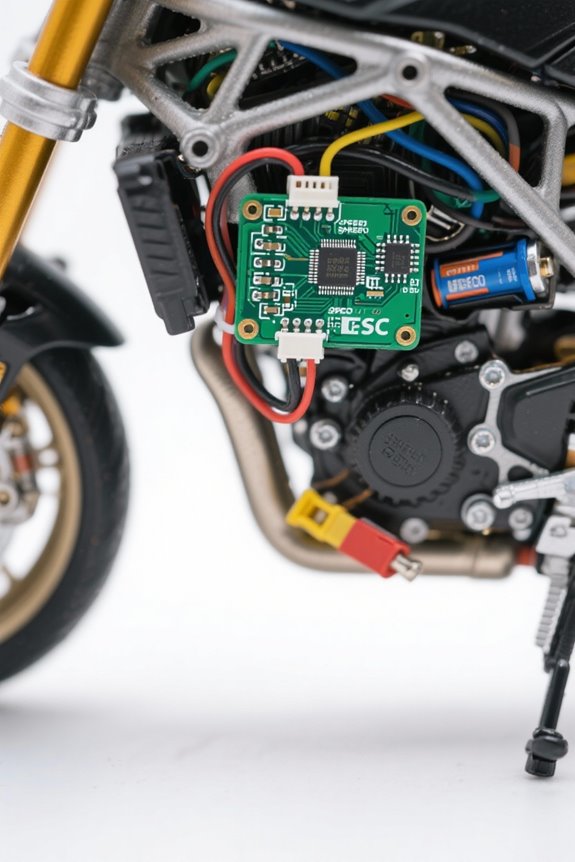
Preparing for calibration is essential to guarantee peak performance of our RC motorcycle. Wheel Maintenance involves making sure the RC motorcycle is elevated or has its wheels removed. This prevents unintended movement during calibration, keeping the process safe and effective. Battery Selection is vital; we should use fully charged batteries that match our motorcycle’s specifications. This avoids voltage drops, promoting accurate calibration outcomes. Connecting the ESC securely to both the motor and receiver assures signal integrity, critical for performance. Finally, we should power off devices before making connections, reducing damage risks. By following these steps, we create an ideal setup that allows for precise calibration, ultimately enhancing our vehicle’s responsiveness and control. Additionally, understanding battery life requirements can help in selecting the appropriate batteries for optimal performance.
Safety Precautions During Calibration

To guarantee maximum safety during calibration, we must adhere to specific precautions that protect both ourselves and our equipment. Open Environment is essential; placing the RC motorcycle in a spacious area free from obstacles minimizes calibration hazards and accidental damage. Equipment Preparation involves removing any propellers or attachments that could cause injury if the motor activates unexpectedly. We should ascertain the motorcycle is stationary, preferably on a stand, to prevent unintended movement. Conducting thorough equipment checks includes verifying the correct battery connections and confirming all wires are secure. Additionally, setting the throttle trim to neutral prevents inadvertent motor activation. By following these steps, we safeguard our well-being and guarantee a successful calibration process. It’s also wise to consider the availability of parts to ensure easy access for any future repairs.
Step-by-Step ESC Calibration Procedure

Before we begin the calibration process, it’s important to guarantee all safety precautions have been followed to create a safe working environment. Initial Setup and Preparations involve confirming that the ESC is securely connected to both the motor and the RC receiver, ensuring calibration accuracy. Next, we power on the transmitter with the throttle stick at neutral and centered throttle trim. After this, we initiate Full Throttle Signal Calibration by setting the throttle at maximum before connecting the battery, waiting for beeps indicating max throttle recognition. Then, we quickly return to neutral, ensuring the ESC confirms this with a beep. This calibration significance is crucial for accurate throttle behavior, preventing unintended spins and establishing a reliable throttle response. Accurate calibration methods enhance performance in various RC vehicles such as Traxxas models.
Adjusting Throttle Endpoints for Accuracy
Endpoint Tweaking involves cycling through full throttle and zero throttle positions during calibration, allowing the ESC to recognize minimum and maximum positions effectively. Remember, we should conduct this process in a safe environment, ensuring all components are secure. By calibrating our throttle endpoints every time we change our ESC or transmitter settings, we maintain precise control, enabling peak performance on varied terrains and conditions. Additionally, understanding the importance of flight stability features can enhance your overall RC experience and improve handling.
Throttle Range Configuration for Smooth Operation
Incorporating these practices ultimately results in smoother operation, providing us with precise control during rides. Additionally, fine-tuning the braking system ensures that riders can achieve optimal stopping power and safety at high speeds.
Different Calibration Methods by ESC Type
When we examine different calibration methods, it’s crucial to recognize that each ESC type has unique requirements and features that influence their setup.
Brushed ESCs require manual adjustments of throttle output parameters, such as SERVOx_MAX and SERVOx_MIN, to establish correct throttle ranges. Careful tuning of SERVOx_TRIM guarantees the motor stops effectively, especially with reversing ESCs.
Digital Protocol ESCs, like those using DShot or CAN, generally eliminate the need for traditional throttle range calibration. With preset timing ranges embedded in the digital control signal, these ESCs provide precise throttle commands that reduce manual adjustments. Utilizing advanced control systems enhances speed management and handling, ensuring optimal performance in various riding conditions.
Understanding these calibration methods helps us achieve maximum performance for our RC motorcycles, enhancing throttle accuracy and control tailored to our specific ESC types.
Utilizing Software for ESC Configuration
Utilizing software for ESC configuration allows us to fine-tune various parameters that enhance performance and adaptability of our RC motorcycles. Software Interface: By connecting our ESC to a computer using the dedicated USB interface, we access a graphical user interface (GUI) for adjustments. Parameter Adjustments: We can calibrate throttle range, braking force, and acceleration curves directly through the software, optimizing responsiveness based on our driving style. Firmware Updates: Regular Firmware Updates guarantee we’re using the latest features, improving our ESC’s performance and compatibility. Testing and Storage: Adjusted settings can be saved directly onto the ESC, allowing us to test changes in real-time, guaranteeing everything runs smoothly for an exhilarating ride. Additionally, ensuring compatibility with features like 2.4 GHz radio control can significantly enhance the overall racing experience.
Common Calibration Pitfalls and Solutions
Common Calibration Pitfalls: Proper calibration of your RC motorcycle’s ESC can markedly enhance performance, but several common pitfalls can hinder our success.
Incorrect Throttle Endpoint Settings: If throttle endpoints extend beyond our stick range, we can’t achieve full throttle or neutral. Ensuring we follow the specific calibration sequence is essential for success.
Failure to Save Calibration Parameters: Not disconnecting power after calibration prevents saving settings. We should always cut power to finalize the calibration.
Misinterpretation of Neutral and Reverse Settings: An improperly set neutral position can cause unintended speeds. We need to verify transmitter configurations before proceeding.
Inconsistent Calibration Procedures: Each ESC model has unique instructions, making it crucial to reference manufacturer manuals. This precaution helps us navigate calibration challenges and allows for effective troubleshooting techniques. For instance, checking specifications related to high-torque brushless power system is important for determining appropriate settings.
Maintaining Optimal ESC Performance
Throttle Optimization involves adjusting throttle rate control settings to balance power delivery with control. We should aim for settings between 20-25 for versatile performance across different track conditions. Additionally, programming ESC throttle curves allows us to efficiently manage acceleration while reducing wheel spin, ensuring smoother power delivery. Together, effective temperature monitoring and Throttle Optimization enhance our performance and prolong equipment lifespan in high-demand scenarios.
Testing Motor Response Post-Calibration
Initial Motor Response Evaluation plays a vital role in confirming the accuracy of our ESC calibration. We start with Visual and Preliminary Check, measuring motor startup smoothness by observing rotor spin post-calibration. We’re looking for consistent spinning without stalls or unusual noises, which guarantees reliability. Next, we conduct Electrical Continuity Tests, using a multimeter to check for any shorts or damaged components. It’s essential to inspect all MOSFETs for physical signs of damage. Then comes Motor Speed Validation, where we test throttle signals. Smooth speed changes confirm effective throttle calibration methods, assuring responsiveness. Finally, during Functional Verification, we repeat acceleration cycles to secure consistency in motor control, emphasizing the importance of precise motor response testing for ideal performance.
Best Practices for Future ESC Adjustments
After confirming consistent motor response through rigorous testing, we can focus on implementing Best Practices for Future ESC Adjustments.
Safety First: Always remove rotating parts, like wheels, during calibration to prevent accidents.
Environment Matters: Calibrate in a secure space, guaranteeing any unintended acceleration won’t cause damage.
Document Everything: Keep track of baseline settings and adjustments for effective performance monitoring.
Incremental Adjustments: Make small changes to ESC settings, testing throttle response after each tweak to verify stability.
Backup Configurations: Maintain a backup of previous settings, allowing quick restoration if new adjustments destabilize performance.
Additionally, considering battery life is crucial for ensuring your RC motorcycle operates effectively during calibrations and testing.
Following these practices enhances our control and fosters a dependable setup, helping us enjoy our RC motorcycle experience to its fullest.
Frequently Asked Questions
How Do I Know if My ESC Is Compatible With My Motorcycle?
To guarantee our ESC’s compatibility with our motorcycle, we should closely review the ESC specifications, conducting thorough compatibility testing. Let’s collaborate on this journey, ensuring we mix the right components without risk or frustration.
What Tools Are Required for ESC Calibration?
For ESC calibration, we need essential tools like a transmitter, fully charged batteries, and calibration software. A servo tester can help guarantee response accuracy while a safe workspace keeps us secure during the process.
Can I Calibrate Multiple ESCS Simultaneously?
Oh, the joy of thinking we can breeze through simultaneous calibration of multiple ESCs! While it’s possible, we must align them perfectly first, or chaos reigns. Let’s embrace the challenge together for better results!
How Often Should I Recalibrate My ESC Settings?
We should recalibrate our ESC settings frequently to guarantee ideal performance. It’s wise to recalibrate whenever we change transmitters, firmware, or batteries, or notice any irregular throttle response. Regular checks keep our setups responsive and reliable.
What Should I Do if Calibration Fails Repeatedly?
When calibration fails repeatedly, we must become seasoned sailors steering through stormy seas. Let’s explore troubleshooting tips and calibration alternatives together, ensuring our ship remains steady while we uncover the right course to success.


