As an Amazon Associate, we earn from qualifying purchases. Some links on this site are affiliate links at no extra cost to you. Our recommendations are based on thorough research and editorial judgment.

How To Build Competition-Ready RC Motorcycles?

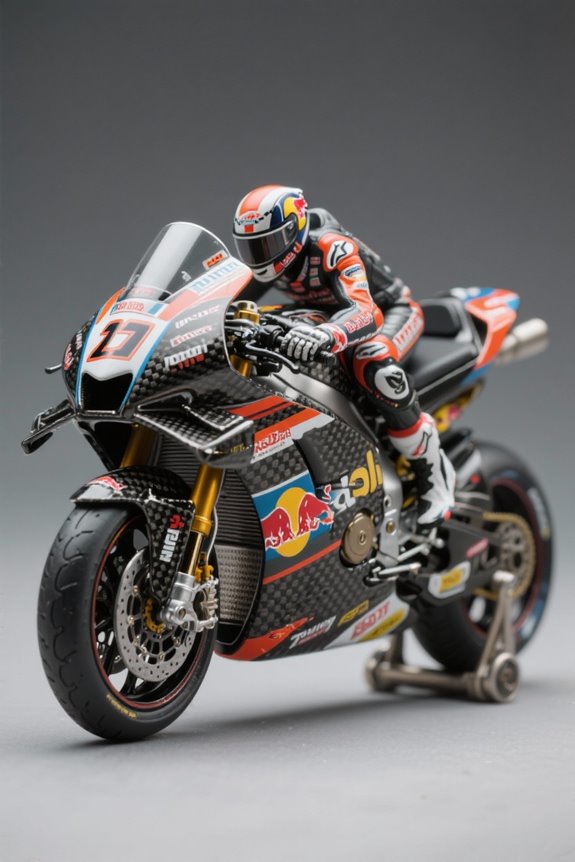
To build competition-ready RC motorcycles, we must adhere to Scale Regulations, ensuring a wheelbase of 280mm to 320mm and a height of 240mm to 300mm. Selecting the right Motor and Battery involves using brushless systems, matching the motor’s KV rating with battery voltage. Chassis and Bodywork should balance rigidity and weight, while choosing Tires and Wheels means considering grip and wear. Ensuring Technical Safety Compliance keeps us safe and competitive, setting the stage for success. More details follow.
Key Takeaways
- Ensure your RC motorcycle meets scale regulations, including wheelbase, height, and grip cutout requirements for safety and performance.
- Select a suitable brushless motor and LiPo battery combination, aligning the motor’s KV rating with the battery voltage for optimal performance.
- Choose a chassis design that offers the right balance of stiffness and durability while considering the material for performance advantages.
- Conduct thorough pre-race checks of all electronics and tires, confirming their suitability for track conditions to ensure reliability during races.
- Regularly maintain and clean your motorcycle, inspecting components for wear, to enhance performance longevity and readiness for competition.
Understanding Scale Regulations
Understanding Scale Regulations is essential for anyone looking to build competitive RC motorcycles. Scale Dimensions and Size Limits specify that for 1/5th scale models, the wheelbase must measure between 280mm and 320mm, which guarantees compliance with international racing standards. The overall height, including the rider figure, should fall between 240mm and 300mm. Appearance Requirements stipulate that body fairings and riders must adhere to these dimensions, ensuring realistic aesthetics and eligibility. Cutouts for grip must not exceed 8mm to mitigate safety hazards. Achieving compliance with these specifications is crucial for competitive participation, as they enhance not just appearance but also performance on the track, creating a fair environment where every competitor can shine. Additionally, understanding performance specifications can help you select the best components for your build to optimize speed and handling.
Selecting the Right Motor and Battery

When selecting the right motor and battery for our RC motorcycles, choosing between different motor types is vital for achieving ideal performance. Motor Type plays a notable role; brushless motors, for example, are generally preferred for their efficiency and higher power output, especially in competitive settings. Inrunner motors provide high speeds suitable for racing, while outrunners deliver more torque and easier setups. Battery Ratings directly influence motor performance; LiPo batteries often offer 1S to 3S options, affecting power output markedly. Selecting a motor’s KV rating must align with the battery voltage to guarantee top RPM and torque. Confirming compatibility between our ESC, motor, and battery is also essential, as this integration maximizes performance and efficiency in our builds. Many racing enthusiasts opt for high-performance models with exceptional specifications that support competitive racing requirements.
Chassis and Bodywork Selection
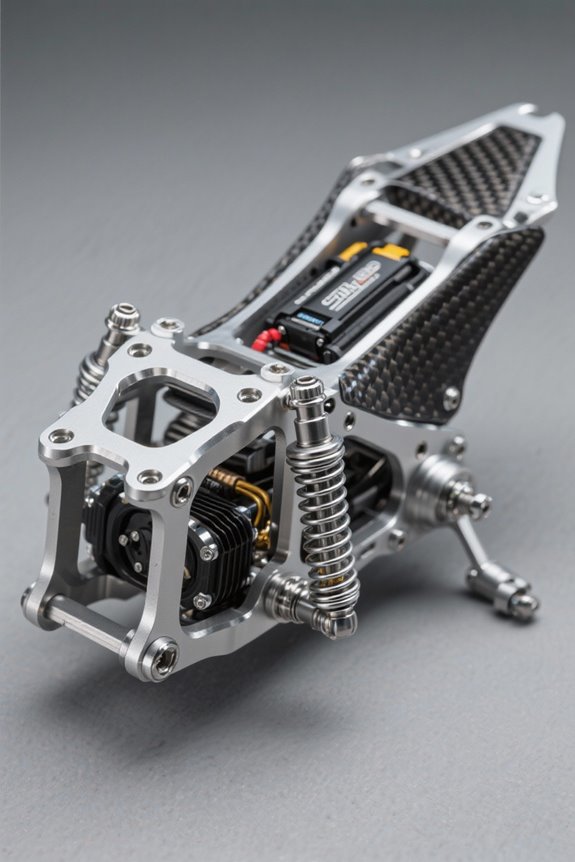
Selecting the right chassis type and bodywork materials is essential for the overall performance and reliability of our RC motorcycles. Chassis Materials like carbon fiber provide rigidity for racing but can be brittle. Aluminum offers a sturdy balance, while plastic is lightweight but less durable. Bodywork Aerodynamics matters too; a well-designed body can reduce drag, enhancing speed and stability. We should favor materials that allow for easy repairs, maximizing our track time. Whether we opt for a monocoque design for stiffness or a ladder frame for off-road toughness, our chassis choice impacts handling and durability. Ultimately, aligning our selection with intended use guarantees our RC motorcycle meets competition standards while reflecting our passion for the hobby. Additionally, considering battery life can greatly influence overall performance and playtime, which is crucial for competitive racing.
Choosing Appropriate Tires and Wheels

Choosing the right tires and wheels is essential for maximizing performance in RC motorcycle racing. Tire compounds greatly influence traction, wear, and temperature tolerance; we prefer softer compounds for increased grip, although they typically wear out faster, while harder compounds provide durability at the cost of traction. Tire size also plays a significant role; wider tires increase the contact patch, enhancing grip without relying solely on softer materials. Additionally, we must consider wheel types; lightweight and durable materials improve handling and responsiveness. Properly matching Tire size to the associated wheel diameter, typically 1.9″ or 2.2″, guarantees peak performance. Together, these choices directly affect our competitive edge, improving both stability and handling during races. It’s important to note that interchangeable tires can offer different racing styles depending on the conditions and track layout.
Ensuring Technical Safety Compliance

Ensuring compliance with safety standards is a key component in building and racing RC motorcycles. Handlebar and Control Lever Safety Standards dictate that solid stops must provide at least 30 mm clearance between handlebars and the motorcycle body at full steering lock, helping to prevent finger trapping during maneuvers. Safety Wiring is mandatory for securing critical components like oil filter cover bolts, which prevents loosening during races. Each control lever, such as brake and clutch, must feature permanently fixed, ball-ended tips, measuring a minimum diameter of 16 mm. Protective Measures like front and rear axle sliders and bar end sliders further safeguard against impacts. By following these standards, we enhance both safety and performance, creating a safer racing environment for everyone. Additionally, incorporating advanced braking systems from high-performance models can significantly improve control and safety during high-speed racing scenarios.
Navigating Racing Rules and Penalties
Maneuvering racing rules and penalties can be complex, but understanding these regulations is essential for competitive success and overall safety. Penalty Types like those for jumpstarting or shortcutting can notably alter our standings. For instance, a jumpstart incurs a 10-second penalty, while shortcutting results in a one-lap deduction. Rule Enforcement is equally crucial; race officials apply penalties immediately to maintain fairness. Each bike must not exceed 8.40 volts to avoid disqualification, and equipment must comply with size regulations to prevent advantages. Precision in adhering to these specifications aids in avoiding penalties and guarantees compliance during heats and finals. By mastering these elements, we can enhance our performance while remaining steadfast in the race. Additionally, familiarizing ourselves with battery life and efficiency can help us strategize our race approach to maximize speed without risking disqualification.
Setting Up the Suspension and Steering
Setting up the suspension and steering on our RC motorcycles is a detailed process that greatly affects our performance on the track. Front Suspension Setup and Sag begins with measuring static sag to confirm we’ve got the correct spring rates; typical values for road/race bikes fall between 15-28 mm, depending on the fork type and model. We need to adjust preload for proper rider sag, vital for traction during acceleration. Damping Settings are equally important; using factory-recommended baselines helps us fine-tune compression and rebound settings for our riding style. Finally, as we adjust fork tubes in triple clamps, we can modify steering geometry, enhancing handling sharpness while maintaining sag. Regular checks of these adjustments confirm consistent performance during races. Additionally, battery life plays a significant role in maintaining optimal performance during lengthy track sessions.
Preparing for Race Day and Beyond
As we prepare for race day, meticulous planning becomes essential for optimizing our performance and ensuring reliability. Pre-Race Equipment and Component Checks are critical, so we’ll start by securing all chassis screws, hardware, and drivetrain components to prevent any mechanical failures during the event. Next, we’ll consult our pre-race checklist to verify electronics are fully charged, optimizing signal reliability. Tire Inspection is imperative; we’ll install clean tires that suit the track conditions. Additionally, we must check all suspension and steering components for tightness. A good maintenance routine includes thorough cleaning, using degreasers post-race to maintain performance longevity. Finally, let’s stay organized in our pit area, streamlining repairs to maximize our track time and overall race strategy. Remember, utilizing models with customizable drift and racing tires can enhance performance across different surfaces, giving you an edge in competition.
Frequently Asked Questions
What Are Common Mistakes New Builders Make When Assembling RC Motorcycles?
When assembling RC motorcycles, we often overlook wire connections and weight distribution. These mistakes can lead to control issues and poor performance. Let’s confirm we double-check everything for a smoother, more enjoyable riding experience together!
How Can I Improve My Motorcycle’s Aerodynamics for Better Speed?
When we first hit the track, our motorcycle felt like a brick. By refining body design and testing in a wind tunnel, we’ve transformed it into a sleek machine, proving that aerodynamics really make a difference in speed.
What Are the Best Practices for Maintaining My RC Motorcycle After Races?
After races, let’s focus on tire maintenance and engine tuning. We should regularly clean, inspect components, and lubricate to guarantee peak performance. It’s all about keeping our RC motorcycles ready for the next thrilling ride together!
How Do Weather Conditions Affect RC Motorcycle Performance and Setup?
Weather works wonders—or wreaks havoc—on our RC motorcycle’s performance. Tire selection and suspension tuning must adapt to conditions, ensuring we enjoy a smoother ride and safer experience together, regardless of the elements we face.
What Tools Do I Need for Building and Maintaining RC Motorcycles?
For building and maintaining RC motorcycles, we need essential tools like hex drivers, soldering irons, and calipers, along with safety equipment to keep us protected and prepared during our exciting projects together. Let’s get started!


