As an Amazon Associate, we earn from qualifying purchases. Some links on this site are affiliate links at no extra cost to you. Our recommendations are based on thorough research and editorial judgment.


Are Autonomous RC Vehicle Systems The Future?

Autonomous RC vehicle systems are indeed the future, driven by Technological Advancements like machine learning, which enhances operation efficiency through improved decision-making. Control Systems utilize embedded microcontrollers, ensuring precise vehicle maneuvers. With Communication Protocols such as Zigbee, real-time data exchange optimizes responsiveness. Safety Benefits include reduced fuel consumption and minimized travel times. Although challenges like sensor reliability and ethical decision-making exist, ongoing research is addressing these issues, paving the way for enhanced autonomy. Discover more about this evolving field.
Key Takeaways
- Technological advancements in AI and machine learning are significantly enhancing the capabilities of autonomous RC vehicles for multitask driving and environmental perception.
- Improved communication protocols and embedded control systems are facilitating real-time data exchange, ensuring better vehicle control in dynamic environments.
- The push towards increasing autonomy levels indicates a growing interest in fully autonomous systems, potentially transforming various industries.
- Autonomous RC vehicles hold the promise of enhanced safety, lower emissions, and optimized routing, contributing to a more efficient future.
- Continuous research and development are crucial to address challenges such as sensor reliability and ethical decision-making in autonomous vehicle systems.
Technological Advancements Driving Autonomous RC Vehicles
Advancements in Machine Learning and Artificial Intelligence** are fundamentally reshaping the landscape of autonomous RC vehicles, enabling smarter navigation and more efficient decision-making. Convolutional Neural Networks (CNNs) enhance perception in lane-keeping, improving predictability in lateral displacement and angle offsets. Deep Reinforcement Learning (DRL) algorithms replace traditional controllers, allowing for multitask driving capabilities that outperform basic lane-keeping. Vision Transformer (ViT) models are pre-trained and fine-tuned with limited datasets to assist in environmental segmentation for steering commands. Modular ML systems combine simulated and real-world data, improving Sim2Real transferability to enhance overall vehicle behavior. Together, these innovations in sensor integration and machine learning technology allow autonomous RC vehicles to navigate autonomously and respond accurately to their environments, greatly advancing our shared experiences in this exciting field. Furthermore, the use of durable materials** in RC vehicles’ construction, like aluminum and robust plastics, also contributes to their ability to withstand impacts during autonomous operations.
Control Systems and Communication Protocols in Use
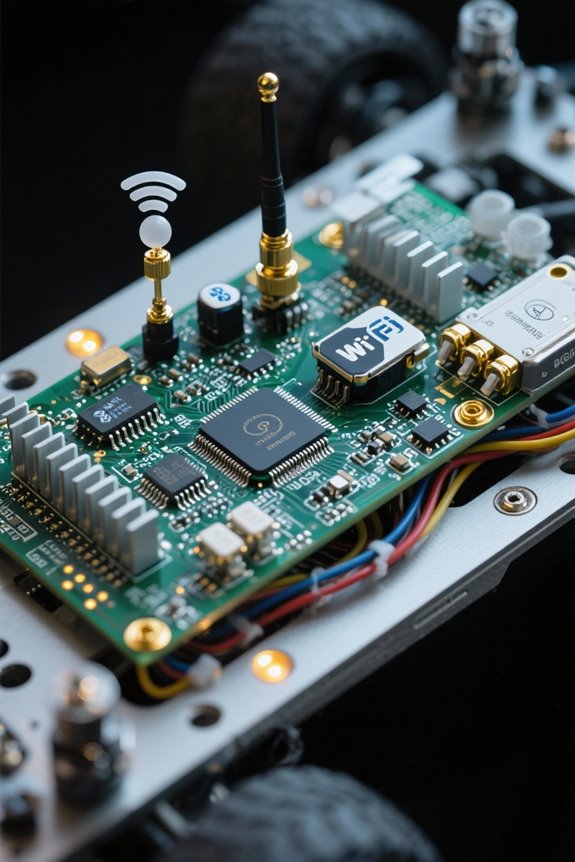
In the domain of autonomous RC vehicles, control systems and communication protocols form the backbone of functionality and effectiveness. Embedded Control Systems typically incorporate microcontrollers like the ESP32 or ATmega series, which handle sensor data processing and motor control commands in real-time. These systems utilize control algorithms, such as PID controllers, guaranteeing smooth acceleration, deceleration, and steering adjustments. Sensor Integration is crucial, combining inputs from sonar, cameras, and laser range finders for enhanced environment awareness. Communication protocols, like Zigbee and UART, enable reliable data exchange between microcontrollers, facilitating decision-making. With real-time monitoring and command execution, we guarantee precise control over our vehicles, allowing them to navigate and respond effectively in dynamic environments, ultimately supporting a seamless autonomous experience. Additionally, the implementation of infrared combat systems can enhance multiplayer capabilities and interaction with other autonomous units on the battlefield.
Benefits of Autonomous Systems for Safety and Efficiency
With regard to efficiency gains, autonomous systems facilitate vehicle-to-vehicle communication, allowing for smoother traffic flow and reducing fuel consumption by 15-20%. Their ability to optimize routing minimizes travel time, resulting in lower emissions and improved road usage. Overall, these safety benefits and efficiency gains make a compelling case for the adoption of autonomous systems. The use of advanced communication technologies in autonomous vehicles further enhances their ability to interact with other vehicles and infrastructure.
Current Levels of Autonomy and Deployment Challenges
As we explore the current levels of autonomy, understanding the SAE classification system helps clarify vehicle capabilities. The levels comparison ranges from Level 0, with no automation, to Level 5, which signifies complete autonomy. Currently, many manufacturers focus on Level 2, providing partial assistance while ensuring driver attentiveness. Level 3, seen in models like the Mercedes-Benz Drive Pilot, allows conditional automation but still requires human readiness to intervene. Deployment hurdles arise in scaling beyond geo-fenced zones due to variable weather, complex road conditions, and intricate human behaviors. As we navigate these challenges, continuous testing, robust safety standards, and regulatory synchronization remain essential. Addressing these hurdles will ultimately bolster the journey toward higher autonomy levels in autonomous RC vehicle systems. The importance of construction quality of RC vehicles, which includes durable materials and efficient design, will also play a pivotal role in their successful implementation.
Market Trends and Future Opportunities for Autonomous Vehicles
What factors are driving the rapid growth of the autonomous vehicle market? Market growth is fueled by advancements in AI technology, leading to more efficient vehicle perception and decision-making capabilities. With global autonomous car revenues projected to reach $42.87 billion by 2026 and $122.04 billion by 2030, significant investment opportunities are arising. The commercial sector, including robotaxis and autonomous trucks, is set to expand further, with projections of a $400 billion market by 2035. Emerging business models, like shared mobility platforms and subscription services, are also gaining momentum, driving urban mobility solutions. By leveraging these trends, we can capitalize on technology improvements, enabling smarter and more efficient transportation options in our communities. Additionally, the development of advanced off-road designs in remote-controlled vehicles illustrates the potential for enhancing autonomous systems in navigating complex terrains.
Key Challenges and Research Directions for Further Development
While the advancements in autonomous vehicle technology offer significant potential, we face vital challenges that hinder further development. Communication and Control Latency Challenges introduce delays that impact the response of remote operators, particularly during high-stakes maneuvers like overtaking. Sensor Reliability is essential; failures can impair safety, necessitating Data Fusion techniques to enhance perception. However, current models require further training and data. Ethical Considerations must guide decision-making in unavoidable accident scenarios, prompting engagement among ethicists and lawmakers. Infrastructure Needs are evolving, with investments required for upgrades and Reinforcement Learning approaches to improve system reliability. Addressing these challenges collectively will enhance safety, build trust, and foster the integration of autonomous vehicles into daily life. Furthermore, leveraging insights on high torque ratings can inform the design of control systems that manage vehicle responses more effectively.
Frequently Asked Questions
How Will Autonomous RC Vehicles Impact Job Markets and Employment Rates?
Autonomous RC vehicles will drive job displacement while sparking workforce evolution. Together, we’ll face challenges but also discover new opportunities in tech and mobility. It’s essential we support each other through these changes, ensuring equitable adjustments.
What Ethical Considerations Arise From the Use of Autonomous RC Vehicles?
When considering autonomous RC vehicles, we must prioritize ethical programming and autonomous safety. It’s essential to guarantee these systems make responsible decisions, balancing technology’s benefits with the moral implications of their actions and publicly sharing accountability.
How Do Weather Conditions Affect the Performance of RC Autonomous Vehicles?
Weather conditions dramatically affect our RC autonomous vehicles’ performance. Rain impacts sensor accuracy, while temperature affects motor efficiency and battery life. Together, these elements challenge our machines, reminding us of the environment’s vital role in their operation.
What Are the Insurance Implications for Owners of Autonomous RC Vehicles?
When we consider the insurance implications for owning autonomous RC vehicles, we must address liability coverage and conduct thorough risk assessment. Understanding these factors helps us navigate potential pitfalls and protect our investments together.
How Can Consumers Ensure Data Privacy With Autonomous Vehicle Systems?
To guarantee our data privacy with autonomous vehicle systems, let’s prioritize strong data encryption and seek clear user consent. By understanding how our data’s used, we can all feel more secure and connected.