As an Amazon Associate, we earn from qualifying purchases. Some links on this site are affiliate links at no extra cost to you. Our recommendations are based on thorough research and editorial judgment.


How To Set Up Telemetry Systems For RC Vehicles?

To set up telemetry systems for RC vehicles, we need sensors like voltage monitors and altimeters, which track critical data. We’ll incorporate radio transmitter and receiver modules, using 2.4 GHz for best range and performance. Wiring should minimize trace lengths and include decoupling capacitors for signal stability. Finally, we can utilize real-time displays for monitoring, enhancing situational awareness. This setup guarantees efficient data collection and transmission, and exploring further will provide us with more detailed guidance.
Key Takeaways
- Select appropriate sensors like voltage, altitude, and temperature for monitoring critical flight parameters in your RC vehicle.
- Choose compatible radio transmitter and receiver modules operating on 2.4 GHz or sub-GHz frequencies for reliable data transmission.
- Design a well-organized circuit layout, minimizing trace lengths and separating analog and digital grounds to avoid interference.
- Implement error checking methods such as CRC validation to ensure data integrity during transmission.
- Use real-time displays and audio alerts to enhance awareness of telemetry data during operations.
Understanding the Basics of RC Telemetry Systems
Telemetry systems are essential components in modern RC vehicles, providing real-time data transmission** that enables us to monitor critical parameters during flight. Telemetry Basics involve the communication between onboard sensors and our transmitter, functioning through wireless radio signals. This allows us to track significant data like battery voltage, altitude, and temperature seamlessly. Data Transmission typically occurs within the 2.4 GHz or sub-GHz frequency bands, ensuring reliable signal transfer. For Sensor Integration, we utilize voltage sensors, GPS units, and temperature sensors, which offer actionable insights. These systems can be uni-directional or bi-directional, enabling two-way communication for precise control. Such features provide essential information, enhancing our flying experience and safety, ultimately allowing us to enjoy our RC hobby without unexpected mishaps. Additionally, the choice of high torque servos** can significantly improve the responsiveness and control of your RC vehicle during telemetry operations.
Essential Components for Telemetry Setup
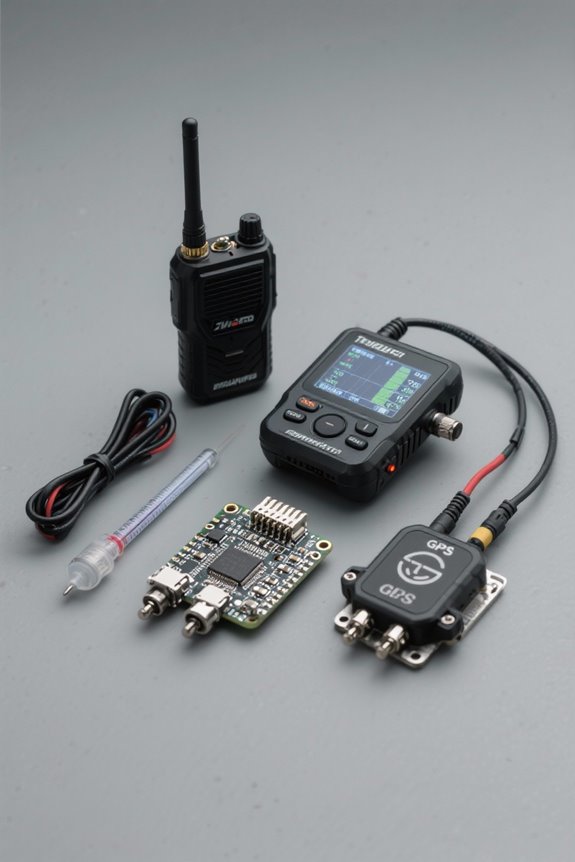
Understanding the components of a telemetry setup is critical for effective data monitoring in our RC vehicles. Radio Transmitter and Receiver Modules form the backbone of the system, with the transmitter (Tx) sending commands and telemetry data wirelessly at frequencies typically around 2.4 GHz. For Sensor Selection, we choose voltage sensors, barometers, and infrared distance sensors to collect valuable data on battery, altitude, and obstacles. Antenna Design affects our transmission range, so we often use 1/4-wavelength designs for prime signal strength. We also prioritize Power Management with voltage regulators like AMS1117, ensuring our components run smoothly. Finally, MCU Integration with low-power microcontrollers enables efficient data processing and timely communication, critical for accurate telemetry operations. Additionally, incorporating ESC protection features can significantly improve the reliability and safety of our telemetry systems by preventing operational failures caused by adverse conditions.
Wiring and Circuit Design for Optimal Performance
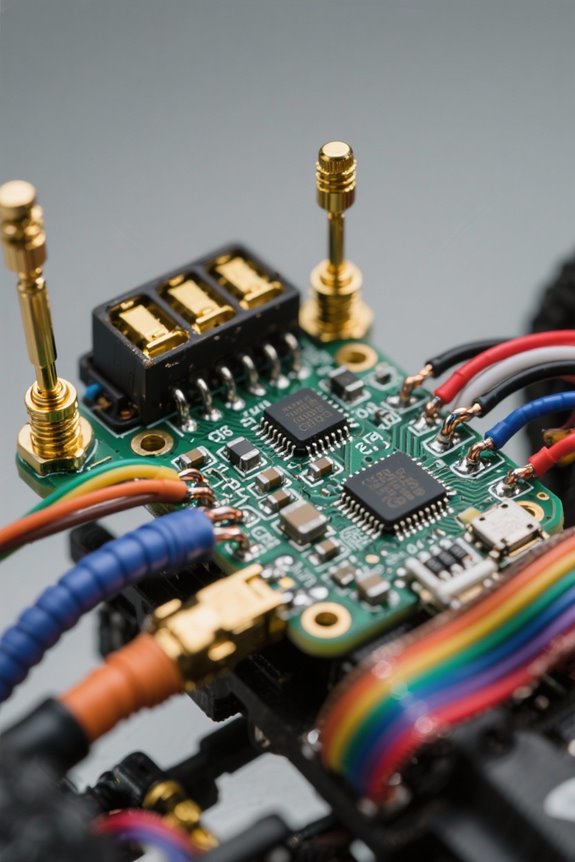
Wiring and circuit design are foundational to optimizing performance in our RC vehicles. PCB and Breadboard Layout Optimization involves minimizing trace lengths between sensor outputs, microcontroller inputs, and transmitters, which reduces signal delay and noise interference. EMI Management is essential; employing dedicated ground planes and separating analog from digital grounds will greatly lower interference levels. Decoupling Capacitors should be placed near each sensor power pin to stabilize voltage, while Signal Conditioning techniques like low-pass filters on sensor outputs help eliminate unwanted noise. By arranging components for direct wiring paths and avoiding crossing high-current lines over sensitive traces, we enhance circuit optimization and guarantee our telemetry systems operate reliably, improving overall performance in our RC applications. Additionally, high-quality materials like carbon fiber can be beneficial for reducing weight, which further enhances the responsiveness of telemetry systems.
Establishing Wireless Communication for Data Transmission
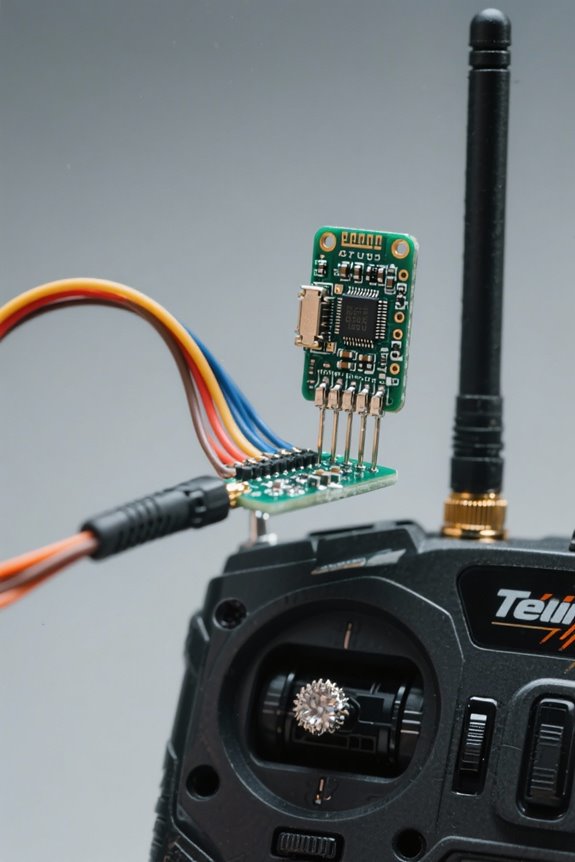
Establishing wireless communication is vital for effective data transmission in our RC vehicles, as it allows us to relay important information in real-time. Radio Frequency and Protocol Selection plays a significant role, where choosing frequencies such as 2.4 GHz or 433 MHz can influence range and interference levels, directly affecting our system’s performance. Antenna Placement is essential; ideal height and orientation reduce signal interference while enhancing range. Modulation Techniques, like Frequency Hopping Spread Spectrum (FHSS) or Direct Sequence Spread Spectrum (DSSS), improve signal robustness. Additionally, considering baud rates from 1-56 Kbaud impacts our data throughput. Together, these elements guarantee reliable communication, enabling us to monitor our vehicles efficiently and react swiftly during our operations. Moreover, selecting receivers with enhanced user experience can significantly boost monitoring capabilities by delivering real-time telemetry data effectively.
Processing and Displaying Telemetry Data Effectively
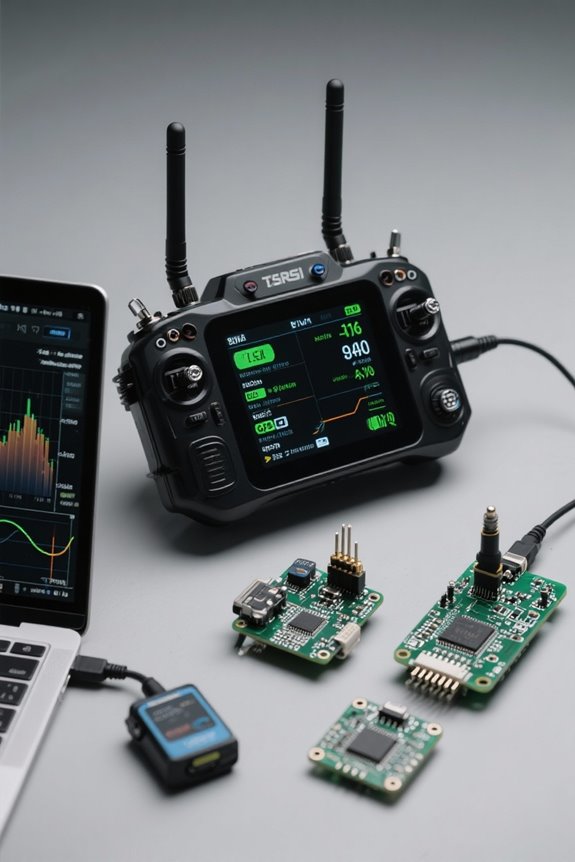
Data streams are correlated to select the highest quality stream prior to processing. Including error checking, such as CRC validation, maintains data integrity before storage. With real-time displays, we feature numeric values on monitors, while audio alerts for critical data leverage situational awareness. Collectively, these strategies enable us to operate effectively, making data accessible and reliable for decision-making. Additionally, proper weight and balance considerations can help optimize telemetry data reliability by ensuring that conditions impacting data collection are minimized.
Frequently Asked Questions
How Do I Choose the Right Sensors for My RC Vehicle?
We choose sensors by considering compatibility with our system and the type of data collection we need. It’s important to verify that everything integrates smoothly, ensuring accurate performance and enhancing our enjoyment of RC vehicles together.
What Is the Maximum Distance for Telemetry Communication?
When we think of long range options for telemetry communication, distances can reach up to 300 meters. However, signal interference and obstacles often keep us grounded, making practical ranges usually around 100 meters in real-world conditions.
Can I Integrate Telemetry With My Existing RC System?
Absolutely, we can integrate telemetry with our existing RC system. By verifying data transmission compatibility and leveraging analytical tools, we’ll enhance our performance, ensuring a smoother and more insightful experience for all of us together.
How Do I Troubleshoot Signal Loss Issues in Telemetry Systems?
To tackle troublesome telemetry troubles, we should meticulously monitor our antenna positioning and minimize signal interference. Staying aware of our surroundings helps guarantee a smoother connection, so let’s unite in enhancing our RC experience together!
What Are the Best Practices for Maintaining Telemetry Accuracy?
To maintain telemetry accuracy, we should regularly use telemetry calibration techniques and implement effective sensor placement strategies. This way, we’ll guarantee precise readings, making our experiences more enjoyable and connected as a community of RC enthusiasts.


